Hello Everyone! This is the end of the semester and the final blog for infectious disease. It has been educational to find articles that were related to topics discussed in class and post them accordingly. I have actually enjoyed microbiology the past two semesters and the lab actually has me considering micro as a potential laboratory that I would like to work in. I hope everyone found the articles that I posted interesting. They demonstrated that what we discussed in lecture and performed in lab are everyday things that affect people worldwide. To all my followers and Mrs. Jeff, thanks for reading my blog and commenting!
Sincerely
Sassay
Assay to Assay
Monday, August 1, 2011

Sunday, July 24, 2011
Virology
This week we in Infectious Disease lecture, we discussed viruses. This included viral structure and testing methods for the viruses. One method of testing, NAAT or nucleic acid amplification testing, has always been interesting to me. NAAT testing is performed on deceased donors who are donating organs for transplantation. The NAAT testing results usually take several hours and if results are indeterminant, it take a lot longer. NAAT testing can be qualitative or quantitative. It can be used to screen for HBV, HCV, HIV,CMV, HSV, and other viruses. NAAT testing was developed to shorten the window period or time or the time a patient has been infected and symptoms appear.

Another testing method that was discussed during lecture was Enzyme-linked immunosorbent assay (ELISA) which is solid phase or membrane immunoassays. Most ELISA assays use a labeled antigen to detect a specific antibody and a captured or sandwich method where an antigen/antibody complex is formed. The picture below demonstrates the steps in the assay.

Thursday, July 14, 2011
Outbreak of Campylobacter in Alaska Linked to Raw Milk

The state of Alaska Section of Epidemiology (SOE) is investigating four recent cases of Campylobacter infection associated with drinking raw milk from an Alaska farm. According to a recent epidemiology bulletin, on June 15, 2011, SOE was notified by the Alaska State Public Health Laboratory of four Campylobacter jejuni isolates with identical pulsed-field gel electrophoresis (PFGE) patterns. After conducting interviews of the four individuals, health officials discovered that the consumption of unpasteurized, or raw, milk was the only exposure common to all ill persons.
During their investigation SOE learned the following:
All four persons with matching Campylobacter isolates experienced acute gastroenteritis in May and June 2011. Patient ages ranged from 1 – 81 years. All four persons were living in Southcentral Alaska at the time of their illness, and all reported consuming raw milk from the same cow share farm in the Matanuska-Susitna Valley.Although Alaska state regulations do not permit the sale of raw milk, owning shares of an animal to receive that animal’s milk is permissible. Unlike milk supplied by commercial outlets, there is no testing or pasteurization required of milk before distribution from a cow-share program.
SOE reported that:
With the onset dates for the four confirmed cases scattered over almost a month-long period, it is unlikely that there was a single “bad batch” of milk, but rather multiple batches of contaminated milk. Raw milk outbreaks can be intermittent and protracted, and this outbreak might well be ongoing. Therefore, we strongly encourage health care providers and the general public to report to SOE all cases of acute gastroenteritis following consumption of raw milk. By interviewing ill persons, we are able to better understand the factors associated with this outbreak and thereby provide more specific control measures to prevent future illness from occurring.In light of the potentially ongoing Campylobacter jejuni outbreak, the Alaska Department of Health and Social Services issued a press release today urging anyone who has consumed raw milk and subsequently experienced acute gastrointestinal illness (i.e. diarrhea, vomiting, cramps, fever) since March 2011 to contact the Section of Epidemiology at 907-269-8000.
Dr. Joe McLaughlin, chief of the Alaska SOE, stated, “Raw milk is an ideal substance for the proliferation of bacteria introduced through fecal contamination.” Moreover, he added, “Unpasteurized milk can be infected with a number of pathogens including Listeria, Salmonella, and as we’ve seen in this case, Campylobacter.”
CLSI Publishes Updated Antimicrobial Susceptibility Testing Standard
The Clinical and Laboratory Standards Institute have recently published the annual update of the well-known antimicrobial susceptibility testing standard, Performance Standards for Antimicrobial Susceptibility Testing; Twenty-First Informational Supplement (M100-S21), which is arranged in tabular format and provides updates of the latest recommendations for detecting emerging resistance of aerobic bacteria.
Therapeutic breakpoints included in the supplement are applied to MIC values determined by standard methods in order to assign an interpretation of susceptible, intermediate, or resistant. This essential information assists clinicians with drug selection and interpretation, and provides quality control and troubleshooting guidelines for clinical microbiology laboratories using the procedures standardized in CLSI documents Performance Standards for Antimicrobial Disk Susceptibility Tests; Approved Standard—Tenth Edition (M02-A10) and Methods for Dilution Antimicrobial Susceptibility Tests for Bacteria That Grow Aerobically; Approved Standard—Eighth Edition (M07-A8).
Clinicians depend heavily on information from the clinical microbiology laboratory for treatment of infected patients, especially those that are seriously ill. The clinical importance of antimicrobial susceptibility test results requires that these tests be performed under optimal conditions within laboratories that have the capability to provide results for the newest antimicrobial agents.
Richard B. Thomson, Jr., PhD, D(ABMM), FAAM, Evanston Hospital, NorthShore University HealthSystem, and the member subcommittee and working groups that developed the document says, “We review and use M100 supplements to stay current with methods needed for accurate antimicrobial susceptibility testing and result interpretation. Clinical microbiologists like myself realize that susceptibility values and interpretive criteria accompanying the culture report are the most important components of the microbiology report. Whether one uses manual or automated susceptibility testing methods, the M100 document is required knowledge for technical, administrative, and medical personnel. In fact, we review content each year with our Infectious Diseases Department and our antimicrobial pharmacist, who refers to our M100 copy so much that we have suggested she get her own!”
Therapeutic breakpoints included in the supplement are applied to MIC values determined by standard methods in order to assign an interpretation of susceptible, intermediate, or resistant. This essential information assists clinicians with drug selection and interpretation, and provides quality control and troubleshooting guidelines for clinical microbiology laboratories using the procedures standardized in CLSI documents Performance Standards for Antimicrobial Disk Susceptibility Tests; Approved Standard—Tenth Edition (M02-A10) and Methods for Dilution Antimicrobial Susceptibility Tests for Bacteria That Grow Aerobically; Approved Standard—Eighth Edition (M07-A8).
Clinicians depend heavily on information from the clinical microbiology laboratory for treatment of infected patients, especially those that are seriously ill. The clinical importance of antimicrobial susceptibility test results requires that these tests be performed under optimal conditions within laboratories that have the capability to provide results for the newest antimicrobial agents.
Richard B. Thomson, Jr., PhD, D(ABMM), FAAM, Evanston Hospital, NorthShore University HealthSystem, and the member subcommittee and working groups that developed the document says, “We review and use M100 supplements to stay current with methods needed for accurate antimicrobial susceptibility testing and result interpretation. Clinical microbiologists like myself realize that susceptibility values and interpretive criteria accompanying the culture report are the most important components of the microbiology report. Whether one uses manual or automated susceptibility testing methods, the M100 document is required knowledge for technical, administrative, and medical personnel. In fact, we review content each year with our Infectious Diseases Department and our antimicrobial pharmacist, who refers to our M100 copy so much that we have suggested she get her own!”
Actinomyces
Actinomyces-Induced Inflammatory Pseudotumor of the Lymph Node Mimicking Scrofula
From University of Chicago, Chicago, IL 60637.
Background: Inflammatory pseudotumor is a rare condition characterized by an aberrant immunologic response that manifests as tumor-like masses in various anatomical locations. Two previous case reports described Actinomyces as a trigger for abdominal inflammatory pseudotumor (1, 2).
Objective: To report what we believe is the first case of Actinomyces-induced inflammatory pseudotumor with primary lymph node involvement.
Case Report: A 34-year-old woman with a history of systemic lupus erythematosus presented to an outpatient clinic with painful swelling on the left side of the neck, a 7-day history of temperatures up to 39.4 °C, and a 3-day history of cough. Her systemic lupus erythematosus was controlled with methotrexate and hydrochloroquine. She received antibiotic therapy for presumed lymphadenitis.
She returned to the clinic 3 days later with no improvement in her symptoms. At that time, physical examination was notable for a firm, tender left submandibular mass without erythema or fluctuance and decreased breath sounds at the right lung base. Chest computed tomography showed a consolidation in the right lower lobe (Figure, A). Further history revealed that the patient had a positive purified protein derivative test several years earlier but did not begin antituberculous therapy. She was admitted to the hospital for suspected reactivation mycobacterial tuberculosis causing pneumonia and lymphadenopathy (scrofula).

Figure. Actinomyces-induced inflammatory pseudotumor with primary lymph node involvement.
A. Noncontrast coronal computed tomographic scan of the lungs showing right lower-lobe consolidation. B. Biopsy specimen of the lymph node showing broadening of connective tissue framework of the lymph node (pale areas) (hematoxylin–eosin stain; original magnification, × 40). C. Higher-magnification view of panel B showing expansion of sclerosed mesenchymal tissue in the trabeculae of the lymph node with proliferation of spindle cells, vessels, and inflammatory cells (hematoxylin–eosin stain; original magnification, × 400).
Fine-needle aspiration biopsy of the lymph node showed reactive features. Transbronchial biopsy of the lung lesion showed chronic inflammation without granulomas. Neither biopsy culture yielded fungal or bacterial growth, including acid-fast bacilli. Results of tests for legionella, histoplasma, and blastomycosis antigen were negative.
Pathologic examination of an excisional biopsy specimen of the lymph node revealed preserved architecture with focal paracortical hyperplasia and inconspicuous lymphoid follicles. In addition, there was expansion of the capsule, trabeculae, and hilum by sclerosed mesenchymal tissue that contained scattered spindly and polygonal cells; small blood vessels; and inflammatory cells, including plasma cells, histiocytes, and lymphocytes, without evidence of organisms, granulomas, or necrosis (Figure, B and C). Immunohistochemistry revealed no phenotypical abnormalities. These findings were consistent with inflammatory pseudotumor of the lymph node (3).
The patient began methylprednisolone therapy, and her neck swelling decreased substantially. After 12 days, the culture from her biopsy specimen yielded Actinomyces species. She started a 12-month course of amoxicillin therapy. Methylprednisolone therapy was switched to prednisone therapy, and she was discharged receiving a regimen of prednisone with a plan to taper the dosage over 3 months. Three months later, she was asymptomatic and repeated computed tomography showed complete resolution of her lung lesion.
Discussion: Inflammatory pseudotumor is a histologic diagnosis characterized by a proliferation of myofibroblasts with an infiltrate of inflammatory cells, such as lymphocytes, histiocytes, and plasma cells (3, 4). Affected patients commonly present with constitutional symptoms and masses in the lungs, spleen, liver, gastrointestinal tract, bladder, orbit, or lymph nodes (4). Inflammatory pseudotumor encompasses a wide spectrum of conditions, including inflammatory myofibroblastic tumor, plasma cell granuloma, or xanthofibroma (5).
Inflammatory pseudotumor may be a primary immunologic lesion in some cases and a reaction to an infection in others. In rare cases, this condition has been linked to neoplastic processes. Inflammatory pseudotumor of the lymph node is a reactive process centered on the connective tissue framework of the lymph node (3). The disease course is usually benign, and this condition is managed with excision or steroids plus treatment of any underlying cause.
In this patient, actinomycosis was the trigger. Actinomyces are gram-positive, filamentous, commensal bacteria normally found in the human gastrointestinal tract. Actinomyces infection generally occurs in immunosuppressed patients or when the integrity of the gastrointestinal mucosal layer is compromised.
Conclusion: Inflammatory pseudotumor represents a diagnostic conundrum, because its clinical features can be consistent with cancer, infectious disease, or primary immunologic disease. No radiologic or laboratory tests are specific for this condition. This case highlights the diagnostic importance of biopsy and cultures in patients who present with fever and unexplained lymphadenopathy
Tuesday, July 12, 2011
Attack of the hyperbugs
Attack of the hyperbugs: We've had superbugs, but now there are strains so resilient that no drugs will kill them
By Alice GrebotLast updated at 10:00 PM on 9th July 2011
The term superbug has become frighteningly familiar over the past decade. These bacteria, which have become resistant to the antibiotics
used to treat them – in other words, the medicines no longer work – are a major cause of hospital-acquired infections and cost the NHS £1billion a year to tackle.An estimated 25,000 patients die of drug-resistant infections each year,
with the most common, MRSA, slowly being superseded by a raft of new, even more deadly strains.
These have been dubbed hyperbugs and are partly fuelled by the growth
of health tourism with patients bringing back new strains from hospitals
abroad.
 Earlier this year, the World Health Organisation warned that the situation
had reached a critical point and said that if no action was taken, 'the
world is heading towards a postantibiotic era, in which many common
infections will no longer have a cure and, once again, kill unabated.'
So what are these bugs, how do you catch them and, more importantly,
how can they be avoided? Here, DR KIM HARDIE, associate
professor in molecular microbiology at Nottingham University, explains what you need to know.
THE EVOLUTION OF A KILLER
Some superbugs are naturally resistant to antibiotics, but in other cases they have undergone changes to enable them to survive.
Mutations (changes) in the genetic code of all cells – ours and the bacteria – happen all the time. If a mutation occurs that prevents a bacterium from
being killed by an antibiotic, this bacterium will live while the others around it are killed when the antibiotic treatment is given.
The resistant bacterium will then reproduce.
Superbugs have evolved in hospitals where there are lots of antibiotics.
The resistant bacteria multiply and share their new genes with other bacteria, which can lead to a set of anti-biotic resistance genes
in a single bacterial cell, and a superbug is born.
WHO IS MOST AT RISK?
Many superbugs live harmlessly on or in the body and only cause problems when the immune system becomes weakened by other illness,
or if they enter a wound.
Those who are already ill are most susceptible as their immune systems
are already busy fighting something else. This also applies to people who have been weakened by surgery, childbirth, old age or drug treatments,for example.
The young are also at risk, especially babies.
HOW DO THEY SPREAD?
In the same way as any other bacteria – through touching contaminated
surfaces and then touching a vulnerable person.
The bacteria may lurk on a surface, someone's hand or be moving from a part of the body where they do no harm to another part where they can cause an infection.
You can catch superbugs anywhere, but you're more likely to find them in a hospital as this is where a high concentration of those susceptible to infection are found.
Alongside wounds, superbugs can enter the body via a device such as a catheter or intravenous line. Others enter through the mouth, nose or urinary tract directly.
HOW TO AVOID THEM
Superbugs are no easier to catch than other germs, so if you practise good hygiene, you can avoid them.
Wash hands well after going to the toilet, before touching wounds or a sick
person, before eating and so on.
There are kits available to protect patients from superbugs, usually containing antibacterial surface wipes, body washes and sprays for fabric.
There is no harm buying one if you or a relative is going into hospital. But
there is soap and alcohol hand gel at the hospital already.
If healthcare workers don't wash their hands when you ask, having a
kit nearby would enable a patient to do something if they were worried,
and reducing stress is a good way to speed recovery from illness.
WHAT ARE THE MOST COMMON TYPES?
Methicillin-resistant Staphylococcus aureus (MRSA) and Clostridium
difficile (C.diff) are the most frequently reported. Staphylococcus aureus (S.aureus) is a common skin bacterium, which has become resistant
to methicillin, a type of penicillin that used to be able to kill it, as
well as other antibiotics.
One in three people have S.aureus living harmlessly on their skin and
in their nose, and a proportion carry MRSA harmlessly. It is only when
bacteria get into a wound that they cause problems. Infection causes
abscesses and boils and can be fatal if it enters the bloodstream.
NHS patients going into hospital for a relevant planned procedure should now be screened for MRSA in advance. If not, you could ask to be, or insist everyone washes their hands before touching you as the MRSA may
come from someone else rather than yourself.
If a patient is found to be carrying MRSA, treatment involves using an antibacterial wash or powder and a special cream in their nose. MRSA infections have also been identified in healthy individuals who haven't
been hospitalised, which is called Community- acquired MRSA.
Methicillinsensitive Staphylococcus aureus (MSSA) is the same bacterium
and produces the same symptoms as MRSA but it is not resistant tomethicillin.
Actress Leslie Ash was awarded a record £5 million in compensation
in 2008 after contracting MSSA while receiving treatment for broken ribs and a punctured lung at Chelsea and Westminster Hospital four years earlier. A spinal infection almost paralysed her and she continues to use a walking stick.
C.diff is a bacterium carried naturally in the gut of around two thirds of children and three per cent of adults. It rarely causes problems in healthy people.
However, some antibiotics can upset the balance of 'good' bacteria
in the gut, allowing C.diff to multiply and attack the body. Symptoms
include diarrhoea and severe inflammation of the bowel which can be fatal.
C.diff is spread through contact from faeces and isn't killed by alcohol
gels, so one should use warm water and soap to wash hands.
RISE OF THE HYPERBUGS
Perhaps the most alarming superbugs around at the moment are S.
aureus strains, which produce a toxin called Panton-Valentine
Leukocidin (PVL). PVL kills white blood cells and skin tissue. Infections
have increased ten-fold in the past six years.
As well as being hard to kill, it is able to infect healthy people. Some strains can't be killed by methicillin.
In 2010, there were 2,227 cases of PVL in England, up from 224 in 2005.
New Delhi metallo-beta-lactamose (NDM-1) is also a concern. NDM-1 is
a gene that can jump between bacteria, making the strain resistant to
some of the most powerful antibiotics that are often used as a last resort
– hence the moniker hyperbug.
Two types of bacteria have been host to NDM-1: the gut bacterium
E.coli and lunginfecting Klebsiella pneumonia. It was brought to the UK by
patients who had travelled to countries such as India or Pakistan for
medical treatment.
There are only two antibiotics left that can kill these bacteria.
According to the Health Protection Agency, 109 cases of bacteria with
NDM-1 have been recorded in the UK to date.
WHAT DOES THE FUTURE HOLD?
Once resistant strains evolve, the number of infections will remain similar (or fall, hopefully, due to improved hygiene).
However, deaths will increase. Since 2005, there have been only two new antibiotics that have been put through trials.
It is essential that procedures and money are put in place to look for and test novel anti-biotics or other forms of drug treatment that will kill bacteria.
In the meantime, the public (and doctors) must learn not to use antibiotics unless they are absolutely necessary.
Unless drastic steps are taken now, a post-antibiotic era is a matter of when, not if.
Read more: http://www.dailymail.co.uk/health/article-2012905/Attack-hyperbugs-Weve-superbugs-strains-resilient-drugs-kill-them.html#ixzz1RuaF1UZ8
used to treat them – in other words, the medicines no longer work – are a major cause of hospital-acquired infections and cost the NHS £1billion a year to tackle.An estimated 25,000 patients die of drug-resistant infections each year,
with the most common, MRSA, slowly being superseded by a raft of new, even more deadly strains.
These have been dubbed hyperbugs and are partly fuelled by the growth
of health tourism with patients bringing back new strains from hospitals
abroad.
New threat: The New Delhi metallo-beta-lactamose (NDM-1) is resistant to most antibiotics
had reached a critical point and said that if no action was taken, 'the
world is heading towards a postantibiotic era, in which many common
infections will no longer have a cure and, once again, kill unabated.'
So what are these bugs, how do you catch them and, more importantly,
how can they be avoided? Here, DR KIM HARDIE, associate
professor in molecular microbiology at Nottingham University, explains what you need to know.
THE EVOLUTION OF A KILLER
Some superbugs are naturally resistant to antibiotics, but in other cases they have undergone changes to enable them to survive.
Mutations (changes) in the genetic code of all cells – ours and the bacteria – happen all the time. If a mutation occurs that prevents a bacterium from
being killed by an antibiotic, this bacterium will live while the others around it are killed when the antibiotic treatment is given.
The resistant bacterium will then reproduce.
Superbugs have evolved in hospitals where there are lots of antibiotics.
The resistant bacteria multiply and share their new genes with other bacteria, which can lead to a set of anti-biotic resistance genes
in a single bacterial cell, and a superbug is born.
WHO IS MOST AT RISK?
Many superbugs live harmlessly on or in the body and only cause problems when the immune system becomes weakened by other illness,
or if they enter a wound.
Those who are already ill are most susceptible as their immune systems
are already busy fighting something else. This also applies to people who have been weakened by surgery, childbirth, old age or drug treatments,for example.
The young are also at risk, especially babies.
HOW DO THEY SPREAD?
In the same way as any other bacteria – through touching contaminated
surfaces and then touching a vulnerable person.
The bacteria may lurk on a surface, someone's hand or be moving from a part of the body where they do no harm to another part where they can cause an infection.
You can catch superbugs anywhere, but you're more likely to find them in a hospital as this is where a high concentration of those susceptible to infection are found.
Alongside wounds, superbugs can enter the body via a device such as a catheter or intravenous line. Others enter through the mouth, nose or urinary tract directly.
HOW TO AVOID THEM
Superbugs are no easier to catch than other germs, so if you practise good hygiene, you can avoid them.
Wash hands well after going to the toilet, before touching wounds or a sick
person, before eating and so on.
There are kits available to protect patients from superbugs, usually containing antibacterial surface wipes, body washes and sprays for fabric.
There is no harm buying one if you or a relative is going into hospital. But
there is soap and alcohol hand gel at the hospital already.
If healthcare workers don't wash their hands when you ask, having a
kit nearby would enable a patient to do something if they were worried,
and reducing stress is a good way to speed recovery from illness.
WHAT ARE THE MOST COMMON TYPES?
Methicillin-resistant Staphylococcus aureus (MRSA) and Clostridium
difficile (C.diff) are the most frequently reported. Staphylococcus aureus (S.aureus) is a common skin bacterium, which has become resistant
to methicillin, a type of penicillin that used to be able to kill it, as
well as other antibiotics.
One in three people have S.aureus living harmlessly on their skin and
in their nose, and a proportion carry MRSA harmlessly. It is only when
bacteria get into a wound that they cause problems. Infection causes
abscesses and boils and can be fatal if it enters the bloodstream.
Struck down: Leslie Ash won £5m damages after catching MRSA
come from someone else rather than yourself.
If a patient is found to be carrying MRSA, treatment involves using an antibacterial wash or powder and a special cream in their nose. MRSA infections have also been identified in healthy individuals who haven't
been hospitalised, which is called Community- acquired MRSA.
Methicillinsensitive Staphylococcus aureus (MSSA) is the same bacterium
and produces the same symptoms as MRSA but it is not resistant tomethicillin.
Actress Leslie Ash was awarded a record £5 million in compensation
in 2008 after contracting MSSA while receiving treatment for broken ribs and a punctured lung at Chelsea and Westminster Hospital four years earlier. A spinal infection almost paralysed her and she continues to use a walking stick.
C.diff is a bacterium carried naturally in the gut of around two thirds of children and three per cent of adults. It rarely causes problems in healthy people.
However, some antibiotics can upset the balance of 'good' bacteria
in the gut, allowing C.diff to multiply and attack the body. Symptoms
include diarrhoea and severe inflammation of the bowel which can be fatal.
C.diff is spread through contact from faeces and isn't killed by alcohol
gels, so one should use warm water and soap to wash hands.
RISE OF THE HYPERBUGS
Perhaps the most alarming superbugs around at the moment are S.
aureus strains, which produce a toxin called Panton-Valentine
Leukocidin (PVL). PVL kills white blood cells and skin tissue. Infections
have increased ten-fold in the past six years.
As well as being hard to kill, it is able to infect healthy people. Some strains can't be killed by methicillin.
In 2010, there were 2,227 cases of PVL in England, up from 224 in 2005.
New Delhi metallo-beta-lactamose (NDM-1) is also a concern. NDM-1 is
a gene that can jump between bacteria, making the strain resistant to
some of the most powerful antibiotics that are often used as a last resort
– hence the moniker hyperbug.
Two types of bacteria have been host to NDM-1: the gut bacterium
E.coli and lunginfecting Klebsiella pneumonia. It was brought to the UK by
patients who had travelled to countries such as India or Pakistan for
medical treatment.
There are only two antibiotics left that can kill these bacteria.
According to the Health Protection Agency, 109 cases of bacteria with
NDM-1 have been recorded in the UK to date.
WHAT DOES THE FUTURE HOLD?
Once resistant strains evolve, the number of infections will remain similar (or fall, hopefully, due to improved hygiene).
However, deaths will increase. Since 2005, there have been only two new antibiotics that have been put through trials.
It is essential that procedures and money are put in place to look for and test novel anti-biotics or other forms of drug treatment that will kill bacteria.
In the meantime, the public (and doctors) must learn not to use antibiotics unless they are absolutely necessary.
Unless drastic steps are taken now, a post-antibiotic era is a matter of when, not if.
Read more: http://www.dailymail.co.uk/health/article-2012905/Attack-hyperbugs-Weve-superbugs-strains-resilient-drugs-kill-them.html#ixzz1RuaF1UZ8
Tuberculosis in Jefferson County Alabama
Tuberculosis (TB) ![]()
Tuberculosis is caused by the bacterium, Mycobacterium tuberculosis. It is spread through the air by a person with an active case of TB located in the lungs when coughing, sneezing or speaking. While TB commonly involves the lungs, TB can develop in other organs including the kidneys, brain, spine, and bone. Not all individuals infected with Mycobacterium tuberculosis will develop an active case of the disease. TB skin and blood testing only indicates if an individual is infected with the organism that causes the disease; the diagnosis of active or latent TB requires additional testing including chest x-rays and sputum cultures. The risk of exposure to TB is increased in high population density settings such as prisons, homeless shelters, and hospitals. Latent TB Infection
In
![]()

In
Individuals with
In 2010, the national rate of tuberculosis (TB) was 3.6 cases per 100,000 population, representing a 3.9% decline in the rate from 2009.
(LTBI) occurs when an individual becomes infected with Mycobacterium tuberculosis, but the immune system is able to contain the bacteria, and the person never develops signs or symptoms of the disease. In this situation, the bacteria are not growing, and the individual with Latent TB cannot transmit the disease to another person. The disease may lie dormant of years, or even a life time, in an individual with Latent TB. TB Disease, the immune system is compromised, and the bacteria begin to grow. If the growth is occurring in the lungs, the individual is capable of transmitting the disease. Individuals with a compromised immune system, such as HIV and transplant patients, are at increased risk for developing the active disease. Active TB generally develop a cough accompanied by chest pain lasting at least three weeks. The coughing may produce blood or sputum in which Mycobacterium tuberculosis can be found. The individual may also experience loss of appetite, weight loss, weakness or fatigue, fever, chills, and/or night sweats. These individuals need to undergo a six to twelve month course of treatment. Failure to comply and complete the course of treatment increases the risk that the TB bacteria develop resistance to the drugs of choice and that the disease remains active. 4 Tuberculosis rates in Jefferson County have also declined, as illustrated in Figure 4.1. Twenty-nine cases of tuberculosis were diagnosed in Jefferson County in 2010, resulting in a rate of 4.4 cases per 100,000 population. During 2010, only 3 of the diagnosed cases were among the homeless, a decrease to 10.3% of all cases from 16.2% (6 cases) in 2009. While the increase in multi-drug resistant (MDR) tuberculosis has been of increasing concern at the national level, there have been no cases of MDR tuberculosis reported in Jefferson County since 2006. 4 Centers for Disease Control and Prevention; Trends in Tuberculosis --- United States, 20109; MMWR 60(11);333-337 (
http://www.cdc.gov/mmwr/preview/mmwrhtml/mm6011a2.htm?s_cid=mm6011a2_e%0d%0a ) 
Infectious Disease in Jefferson County Alabama
Salmonellosis
![]()
The number of cases of Salmonellosis (Figure 1.3) had been steadily rising since 1997 and peaked at 108 cases in 2007. The vast majority of reported Salmonella infections were individual cases. The number of cases (73) and the incidence rate for Jefferson County (11.0/100,000) in 2010 greatly exceeds the 2010 national target of 6.8 cases per 100,000 population. It is suspected that the actual Salmonella rates in Jefferson County have remained relatively stable over the past three years and that some portion of the increase observed in 2007 reflected an increased number of stool cultures performed in response to Shigella outbreaks. The decrease in the number of stool samples cultured since 2008 may also contribute to in the number of cases identified.
Shigellosis
The large increases in the number of cases and resulting rates of Shigellosis in 2001, 2004, 2007 and 2008 reflect outbreaks in childcare facilities (Figures 1.4, 1.5). In each of these years, several childcare facility-related outbreaks were documented throughout Jefferson County. Although the number of daycare associated outbreaks decreased from 11 in 2007 to 2 in 2010, the average number of children affected per outbreak rose from 5 to 12 within the same timeframe.
![]()
Campylobacteriosis
From 1998 through 2005, the number of cases of Campylobacteriosis remained fairly stable. There was a slight increase from 2005 through 2007, from which point the rates have again stabilized at a slightly higher rate (Figure 1.7).![]()

The number of cases of Salmonellosis (Figure 1.3) had been steadily rising since 1997 and peaked at 108 cases in 2007. The vast majority of reported Salmonella infections were individual cases. The number of cases (73) and the incidence rate for Jefferson County (11.0/100,000) in 2010 greatly exceeds the 2010 national target of 6.8 cases per 100,000 population. It is suspected that the actual Salmonella rates in Jefferson County have remained relatively stable over the past three years and that some portion of the increase observed in 2007 reflected an increased number of stool cultures performed in response to Shigella outbreaks. The decrease in the number of stool samples cultured since 2008 may also contribute to in the number of cases identified.
Shigellosis
The large increases in the number of cases and resulting rates of Shigellosis in 2001, 2004, 2007 and 2008 reflect outbreaks in childcare facilities (Figures 1.4, 1.5). In each of these years, several childcare facility-related outbreaks were documented throughout Jefferson County. Although the number of daycare associated outbreaks decreased from 11 in 2007 to 2 in 2010, the average number of children affected per outbreak rose from 5 to 12 within the same timeframe.

Campylobacteriosis
From 1998 through 2005, the number of cases of Campylobacteriosis remained fairly stable. There was a slight increase from 2005 through 2007, from which point the rates have again stabilized at a slightly higher rate (Figure 1.7).

Jesus Heals the Leper
Every time I hear leprosy, I think about Jesus healing leperds.
I am posting a video on leporsy and the Bible passage.
Enjoy
I am posting a video on leporsy and the Bible passage.
Enjoy
Jesus Heals the Leper, Cautions Silence (Mark 1:40-45)
- 40 And there came a leper to him, beseeching him, and kneeling down to him, and saying unto him, If thou wilt, thou canst make me clean. 41 And Jesus, moved with compassion, put forth his hand, and touched him, and saith unto him, I will; be thou clean. 42 And as soon as he had spoken, immediately the leprosy departed from him, and he was cleansed. 43 And he straitly charged him, and forthwith sent him away; 44 And saith unto him, See thou say nothing to any man: but go thy way, shew thyself to the priest, and offer for thy cleansing those things which Moses commanded, for a testimony unto them.
Tuesday, July 5, 2011
Short term Candida albicans colonization reduces Pseudomonas aeruginosa-related injury
IntroductionPseudomonas aeruginosa is a frequent cause of ventilator-acquired pneumonia (VAP). Candida tracheobronchial colonization is associated with higher rates of VAP related to P.
aeruginosa. This study was designed to investigate whether prior short term Candida albicans airway colonization modulates the pathogenicity of P.
aeruginosa in a murine model of pneumonia and to evaluate the effect of fungicidal drug caspofungin.
Methods: BALB/c mice received a single or a combined intratracheal administration of C. albicans (1 x 10⁵ CFU/mouse) and P.
aeruginosa (1 x 10⁷ CFU/mouse) at time 0 (T0) upon C. albicans colonization, and day 2.
To evaluate the effect of antifungal therapy, mice received caspofungin intraperitoneally daily, either from T0 or from day 1 post-colonization. After sacrifice at day 4, lungs were analyzed for histological scoring, measurement of endothelial injury, and quantification of live P.
aeruginosa and C. albicans.
Blood samples were cultured for dissemination.
Results: A significant decrease in lung endothelial permeability, the amount of P. aeruginosa, and bronchiole inflammation was observed in case of prior C.
albicans colonization. Mortality rate and bacterial dissemination were unchanged by prior C.
albicans colonization. Caspofungin treatment from T0 (not from day 1) increased their levels of endothelial permeability and lung P.
aeruginosa load similarly to mice receiving P. aeruginosa alone.
Conclusions: P.
aeruginosa-induced lung injury is reduced when preceded by short term C. albicans airway colonization.
Antifungal drug caspofungin reverses that effect when used from T0 and not from day 1.
aeruginosa. This study was designed to investigate whether prior short term Candida albicans airway colonization modulates the pathogenicity of P.
aeruginosa in a murine model of pneumonia and to evaluate the effect of fungicidal drug caspofungin.
Methods: BALB/c mice received a single or a combined intratracheal administration of C. albicans (1 x 10⁵ CFU/mouse) and P.
aeruginosa (1 x 10⁷ CFU/mouse) at time 0 (T0) upon C. albicans colonization, and day 2.
To evaluate the effect of antifungal therapy, mice received caspofungin intraperitoneally daily, either from T0 or from day 1 post-colonization. After sacrifice at day 4, lungs were analyzed for histological scoring, measurement of endothelial injury, and quantification of live P.
aeruginosa and C. albicans.
Blood samples were cultured for dissemination.
Results: A significant decrease in lung endothelial permeability, the amount of P. aeruginosa, and bronchiole inflammation was observed in case of prior C.
albicans colonization. Mortality rate and bacterial dissemination were unchanged by prior C.
albicans colonization. Caspofungin treatment from T0 (not from day 1) increased their levels of endothelial permeability and lung P.
aeruginosa load similarly to mice receiving P. aeruginosa alone.
Conclusions: P.
aeruginosa-induced lung injury is reduced when preceded by short term C. albicans airway colonization.
Antifungal drug caspofungin reverses that effect when used from T0 and not from day 1.
Necrotizing fasciitis
Necrotizing fasciitis is a progressive, rapidly spreading, inflammatory infection located in the deep fascia, with secondary necrosis of the subcutaneous tissues (see the images below). Because of the presence of gas-forming organisms, subcutaneous air is classically described in necrotizing fasciitis. This may be seen only on radiographs or not at all. The speed of spread is directly proportional to the thickness of the subcutaneous layer. Necrotizing fasciitis moves along the deep fascial plane.
 Left upper extremity shows necrotizing fasciitis in an individual who used illicit drugs. Cultures grew Streptococcus milleri and anaerobes (Prevotella species). Patient would grease, or lick, the needle before injection.
 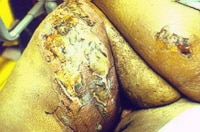 Necrotizing fasciitis at a possible site of insulin injection in the left upper part of the thigh in a 50-year-old obese woman with diabetes.
This condition has also been referred to as hemolytic streptococcal gangrene, Meleney ulcer, acute dermal gangrene, hospital gangrene, suppurative fascitis, and synergistic necrotizing cellulitis. Fournier gangrene is a form of necrotizing fasciitis that is localized to the scrotum and perineal area.
These infections can be difficult to recognize in their early stages, but they rapidly progress and require prompt recognition and aggressive treatment to combat the associated high morbidity and mortality.[1] The causative bacteria may be aerobic, anaerobic, or mixed flora, and the expected clinical course varies from patient to patient.
Left upper extremity shows necrotizing fasciitis in an individual who used illicit drugs. Cultures grew Streptococcus milleri and anaerobes (Prevotella species). Patient would grease, or lick, the needle before injection. Necrotizing fasciitis at a possible site of insulin injection in the left upper part of the thigh in a 50-year-old obese woman with diabetes. This condition has also been referred to as hemolytic streptococcal gangrene, Meleney ulcer, acute dermal gangrene, hospital gangrene, suppurative fascitis, and synergistic necrotizing cellulitis. Fournier gangrene is a form of necrotizing fasciitis that is localized to the scrotum and perineal area.
These infections can be difficult to recognize in their early stages, but they rapidly progress and require prompt recognition and aggressive treatment to combat the associated high morbidity and mortality.[1] The causative bacteria may be aerobic, anaerobic, or mixed flora, and the expected clinical course varies from patient to patient.
Salmonella Typhimurium Infections in Clinical and Teaching Microbiology Laboratories
CDC is collaborating with public health officials in many states to investigate a multistate outbreak of Salmonella Typhimurium infections associated with exposure to clinical and teaching microbiology laboratories. Investigators are using DNA analysis of Salmonella bacteria obtained through diagnostic testing to identify cases of illness that may be part of this outbreak. As of April 20, 2011, a total of 73 individuals infected with the outbreak strain of Salmonella Typhimurium have been reported from 35 states: AK (1), AL (3), AZ (2), CA (1), GA (5), IA (1), ID (2), IL (3), IN (1), KS (1), KY (3), MA (2), MD (2), MI (2), MN (4), MO (2), NC (1), ND (1), NE (2), NJ (2), NM (3), NV (1), NY (1), OH (1), OK (1), OR (1), PA (6), SC (2), SD (1), TN (2), TX (1), UT (3), WA (5), WI (3), WY (1).
Tuesday, June 28, 2011
Salmonella and Your Body :-(
Here is a video on Salmonella spp. entering the body.
http://www.youtube.com/watch?v=gpLUQza4uWw&feature=related
http://www.youtube.com/watch?v=gpLUQza4uWw&feature=related
Salmonella Outbreak
June 27, 2011
WASHINGTON (AP)- The Food and Drug Administration is issuing a rare warning to consumers, asking diners to avoid Evergreen Produce brand alfalfa sprouts or spicy sprouts because they may be linked to 20 cases of salmonella poisoning.
WASHINGTON (AP)- The Food and Drug Administration is issuing a rare warning to consumers, asking diners to avoid Evergreen Produce brand alfalfa sprouts or spicy sprouts because they may be linked to 20 cases of salmonella poisoning.
The Idaho-based company has not recalled the sprouts though the FDA says they are possibly linked to illnesses in Idaho, Montana, New Jersey, North Dakota and Washington state. Nadine Scharf, who identified herself as the co-owner of the company, said Monday that the company has stopped producing the alfalfa and spicy sprouts but is not planning to recall them from store shelves.
Scharf said the FDA has asked her to recall the sprouts but that she doesn't believe the agency has enough evidence to link the illnesses to her products. Most of the sprouts have probably been consumed anyway, she said.
The FDA "inspected every nook and cranny, every part of our plant, and that was a week ago and they haven't come up with anything yet," Scharf said. "We'll see. Maybe they will. Who knows."
While the FDA now has the power to force a recall thanks to a food safety law enacted earlier this year, the agency has not yet used that power. FDA generally works with companies to voluntarily issue a recall before it takes more drastic steps.
The agency's warning to consumers Monday is an unusual step that the agency will generally only take if a company refuses to recall a product and officials believe there is possible danger to those who consume it. Salmonella is an organism that can cause serious and sometimes fatal infections in people with weakened immune systems. It can cause diarrhea, fever and vomiting.
In the warning, the FDA urged consumers not to eat alfalfa or spicy sprouts in plastic bags labeled "Evergreen Produce" or "Evergreen Produce Inc." The agency said it believes they were distributed in Idaho, Montana and Washington state. Scharf said that their products are distributed to Spokane, Wash., where they are then sent to other places.
Raw sprouts are a frequent culprit in foodborne illness because of the moist, warm conditions in which they are grown. At least 47 people have died and 4,000 have been sickened in an outbreak of E. coli in Europe that is believed to be caused by sprouts. FDA officials said the two outbreaks are not related.
There have been at least 30 outbreaks associated with raw or lightly cooked sprouts in the United States in the last 15 years.
Scharf said she thinks the publicity over the European outbreak is causing the agency to be more vigilant.
"Recalling the sprouts that are out there would be like saying I am guilty of having bacterially contaminated sprouts, and as of today they haven't documented the fact that any of our sprouts have bacteria in them," she said.
Monday, June 27, 2011
F.D.A. Approves Drug to Treat Clostridium difficile
F.D.A. Approves Drug to Treat Clostridium difficile As a young infectious disease researcher in 1971, Dr. Sherwood L. Gorbach received an urgent call for help from a drug company. Some patients treated with the company’s antibiotic in New Zealand had developed severe cases of diarrhea and bowel inflammation, and some had died.Dr. Gorbach ended up devoting much of his career to tracking down the cause of that outbreak and pursuing treatments. On Friday, 40 years after he began his quest, the Food and Drug Administration approved a drug he helped develop.The drug, called Dificid, is the first new medicine in 25 years approved to treat diarrhea caused by Clostridium difficile, a nasty and persistent bacterium that one study suggests may have surpassed the better known MRSA as the leading hospital-acquired infection.In clinical trials, Dificid, also known as fidaxomicin, proved better than the only approved drug in keeping patients free of symptoms 25 days after the end of treatment. The new drug was developed by Optimer Pharmaceuticals, where Dr. Gorbach, now 76, is the chief scientific officer.Infections and deaths from C. difficile — the name means "difficult" — have increased sharply since the 1990s, in part because of the spread of a more virulent strain. It is estimated that several hundred thousand Americans are infected each year. Up to 1 percent of patients must have their colons removed and about 5 percent die.While most of those infected are elderly people in hospitals or nursing homes, younger adults and children can also be infected, and there are cases that arise outside the hospital.Problems usually start when people are treated with antibiotics for some other infection. That can kill off many of the harmless bacteria in the intestines, allowing C. difficile, which is resistant to most antibiotics, to take over.Two drugs are now used to treat C. difficile, one of which — metronidazole, a generic antibiotic also sold by Pfizer as Flagyl — was never actually approved for this use. The other is Vancocin, an oral form of the antibiotic vancomycin, which is sold by ViroPharma and was approved in 1986.While the drugs usually clear the diarrhea, it can come back, often more than once."When patients get better and are discharged and have another recurrence, it sets them back to Square 1," said Lynne V. McFarland, an expert at the Puget Sound veterans affairs hospital in Seattle.Dificid might help reduce those recurrences.In two clinical trials involving a total of about 1,100 patients, both Dificid and Vancocin cleared the diarrhea in more than 85 percent of patients by the end of the 10-day treatment period. But in later weeks, roughly 25 percent of the Vancocin users had a recurrence compared with only about 15 percent of the Dificid users.The net result was that 25 days after the end of treatment, about 70 percent of those treated with Dificid were still free of disease compared with 57 percent of those treated with Vancocin, according to Dificid’s label.The main side effects are nausea, vomiting, abdominal pain and gastrointestinal hemorrhage.Dificid is the first approved product for 13-year-old Optimer, which is based in San Diego. Cubist Pharmaceuticals will help market the drug, which is a tablet taken twice a dayEun K. Yang, an analyst at Jefferies & Company, has predicted annual sales could reach $159 million by 2015.Vancocin had sales of $259.6 million in 2010, up 22 percent because of price increases, while the number of prescriptions declined. ViroPharma has said that C. difficile infections in the United States may have leveled off or declined since 2008.Optimer declined to disclose the price of Dificid until a conference call with analysts on Tuesday. But the drug is likely to be at least as expensive as Vancocin, which costs $1,000 or more for a course of treatment.A high price might limit Dificid’s use to the most severe cases. Generic versions of Vancocin could be approved in the coming year, which would hurt sales of Dificid.For Dr. Gorbach, the approval was a coda to a career spent mostly as a professor of medicine and public health at Tufts University.It was there that he and colleagues identified toxin-producing clostridia as the culprits in the New Zealand outbreak. Upjohn, the manufacturer of the antibiotic involved, paid for the research. The finding was published in The New England Journal of Medicine in 1978.In 2003, Dr. Gorbach was asked for advice by another pharmaceutical company, Optimer. He grew excited when he learned that hamsters treated with fidaxomicin had remained healthy even after treatment stopped."All the other drugs, when you stop the treatment, they all die within two or three days," he said.In 2005, while keeping his post at Tufts, he joined the company
French E. Coli Episode Seems Isolated, Officials Say
French E. Coli Episode Seems Isolated, Officials Say
The French authorities said Sunday that the latest outbreak of a deadly strain of E. coli in Europe appeared to be isolated, even as European Union officials discussed wider action to restrict sales of bean sprouts, the suspected cause of the outbreak.
Seven patients remained hospitalized Sunday, said Véronique Seguy, a spokeswoman for the regional health agency in Aquitaine, in southwestern France, where the outbreak occurred.
Tests indicated that the patients were sickened by E. coli O104:H4, the same strain of bacteria that has killed 43 people in Germany and one in Sweden in recent weeks, Ms. Seguy said.
Two patients in France were in intensive care, Ms. Seguy said. But no new cases have been reported in recent days, an indication that the outbreak was an isolated event.
Most of the infections in France have been linked to a charity event at a children’s play center in Bègles, a suburb of Bordeaux, on June 8. Most of the people who became ill recalled eating gazpacho garnished with sprouts. Sprouts were also identified as the source of a German outbreak.
Britain and Ireland were among the European countries that warned consumers over the weekend against eating any raw bean sprouts or other sprouted seeds.
So far the bloc has not issued any continentwide restrictions, but national experts were scheduled to speak by telephone later on Sunday to discuss whether the evidence gathered in the French and German cases was sufficient to restrict sales of sprouts.
I expect the experts will be asking if it’s entirely a coincidence that bean sprouts have come under suspicion twice in the space of just one month as responsible for such an unusual and dangerous and deadly strain of E. coli," said Frédéric Vincent, a spokesman for the European health commissioner.
Mr. Vincent said that some of the discussions would focus on whether the problem originated with the sprouts or with seeds used to grow the sprouts, and whether the seeds came from inside or outside the European Union. He said the European Commission had not ordered any suspect produce to be removed from the market because it was waiting for more evidence of the source of the latest outbreak.
Another likely reason for caution is that the commission, the European Union’s executive body, has come under intense pressure to coordinate hundreds of millions of dollars’ worth of compensation to farmers for losses incurred on produce they had to take off the market after Spanish cucumbers were wrongly identified as a likely source of the outbreak in Germany.
Over the weekend a British seed company, Thompson & Morgan, rejected responsibility for the outbreak after a French official said that the sprouts used in the gazpacho were from seeds supplied by the company.
"We note that the French outbreak was localized to a specific event, which would indicate to us that something local in the Bordeaux area, or the way the product has been handled and grown, is responsible for the incident rather than our seeds," the statement said.
The company said it was cooperating with the British health authorities
Richard Howitt, a British member of the European Parliament, warned the French authorities against blaming the company, which is in his constituency, without definitive proof. Mr. Howitt said seeds for the sprouts could have picked up bacteria in Italy, where the company had sourced them. He also said that the French should be held responsible for any damage to the vegetable and salad markets in Britain if the company was not to blame.
In Britain, the Food Standards Agency said Saturday that no cases of food poisoning had been reported there that were linked to the outbreak in France. But it warned that sprouted seeds — including alfalfa, mung beans and fenugreek — "should only be eaten if they have been cooked thoroughly until steaming-hot throughout."
The Food Safety Authority of Ireland warned that "consumers should not eat raw bean sprouts or other sprouted seeds, and caterers should not serve raw bean sprouts or other sprouted seeds." The Irish authority also warned of "the possibility that contaminated seeds are on the market," and it said that if "those seeds are still in circulation, other outbreaks could occur."
The outbreak of E. coli is one of the deadliest to affect Europe in recent years, though it abated in Germany after the health authorities located its main source: sprouts grown on an organic farm in Lower Saxony in northern Germany.
Some of the cases could have been caused by the bacteria’s entering parts of the drinking water system, according to the health authorities in the German state of Hesse and the Robert Koch Institute, the German federal institution responsible for disease control.
Helge Karch, the director of the Institute for Hygiene at the University Hospital in Münster, Germany, writing in the latest issue of The Lancet, said the authorities had underestimated how the bacteria could have entered the drinking water.
Still, a spokeswoman for the Hesse Ministry for Social Affairs, which deals with health and consumer affairs, said last week that so far there was no danger of a complete contamination of the water system.
Thursday, June 23, 2011
ACCURATE RESULTS ARE CRUCIAL!
State government officials and operators of the criminal justice system hope bad news is old news when it comes to the Indiana Department of Toxicology, soon to be under new management.
The news isn't getting better. An independent audit of positive cocaine test results for criminal cases between 2007 and 2009 found that 32 percent of the tests fell short of accepted scientific standards.
That compares to a 10 percent error rate for marijuana for the period, a finding that stirred great concern back in April. Results for alcohol, then for amphetamines and other drugs, are yet to come.
Hundreds of prosecutions could be affected. While procedural missteps do not necessarily indicate false positives -- and wrongful convictions -- the error rate for cocaine raises "a distinct possibility that there are some false positives," says former Marion County prosecutor Scott Newman, who is troubleshooting the lab.
The lab, which serves every county expect Marion, has been run by Indiana University since 1957. A new law enacted in response to its troubles shifts the job to a state government agency as of July 1.
That's encouraging in a couple of ways. It calls for a director and an advisory board with toxicology savvy and requires national accreditation. The period of the disturbing audits was one in which the lab was headed by a person without toxicology credentials, and Newman says the staff lacked direction either from management or protocol. National accreditation should set that path, as well as subjecting the lab to regular outside inspection.
The question remains, however, whether new proprietorship can handle the immense caseload yielded by the wars on drugs and drunken driving. Inadequate staffing and underfunding have been cited as culprits in the poor audit results, and the budget for the lab has been cut to $2.1 million from $2.5 million.
State Sen. Thomas Wyss, co-chairman of a gubernatorial assessment team that recommended the transfer from IU, says he is open to endorsing more if the advisory council makes a case later. Steven Johnson, executive director of the Indiana Prosecuting Attorneys Council, agrees that the money is sufficient. The final outcome of the audit will have much to say about that issue. And in light of the embarrassing results so far, who can refute Larry Landis, executive director of the Indiana Public Defender Council, when he argues the audit should be extended to pre-2007?
The advisory council will have to decide that as well, Scott Newman says. It's going to be a group with quite a job on its hands.

Bordetella Pertussis
Smithtown, NY (SmithtownRadio.com) – Fourteen students in three Smithtown area schools have been sicken with whooping cough.
Whooping cough, also known as pertussis, is a highly contagious respiratory disease, according to the Center for Disease Control. It is caused by the bacterium Bordetella pertussis
In a pre-recorded phone call to school district parents Wednesday morning, Superintendent of Schools Ed Ehmann said nine cases were reported at Nesaquake Middle School, four at St. James Elementary School and one at Tackan Elementary School. Ehmann also said that letters would be sent out to parents in those three schools but decided to make the phone calls today to because he “wanted to let everyone know this situation exists.”
Pertussis is known for uncontrollable, violent coughing which often makes it hard to breathe. In addition to the cough, runny nose and a slight fever are also symptoms.
Smithtown school students are immunized against the disease, which is reportedly helping to reduce the severity of the illness. However, public health officials advise that the pertussis immunization may be only 80 percent effective and that protection from the vaccination often wanes by the pre-pubescent years.
“Pertussis has been common in the community in recent years, mostly among adults, in whom immunity has waned,” said Suffolk County Health Commissioner James L. Tomarken in a released statement Tuesday. “While most individuals will recover fully from pertussis, we are concerned about infants who have not received full immunization and to whom pertussis is particularly dangerous and can be fatal.”
Suffolk County public health officials have alerted area pediatricians of the outbreak and have advised school officials to implement appropriate infection control measures.

Whooping cough, also known as pertussis, is a highly contagious respiratory disease, according to the Center for Disease Control. It is caused by the bacterium Bordetella pertussis
In a pre-recorded phone call to school district parents Wednesday morning, Superintendent of Schools Ed Ehmann said nine cases were reported at Nesaquake Middle School, four at St. James Elementary School and one at Tackan Elementary School. Ehmann also said that letters would be sent out to parents in those three schools but decided to make the phone calls today to because he “wanted to let everyone know this situation exists.”
Pertussis is known for uncontrollable, violent coughing which often makes it hard to breathe. In addition to the cough, runny nose and a slight fever are also symptoms.
Smithtown school students are immunized against the disease, which is reportedly helping to reduce the severity of the illness. However, public health officials advise that the pertussis immunization may be only 80 percent effective and that protection from the vaccination often wanes by the pre-pubescent years.
“Pertussis has been common in the community in recent years, mostly among adults, in whom immunity has waned,” said Suffolk County Health Commissioner James L. Tomarken in a released statement Tuesday. “While most individuals will recover fully from pertussis, we are concerned about infants who have not received full immunization and to whom pertussis is particularly dangerous and can be fatal.”
Suffolk County public health officials have alerted area pediatricians of the outbreak and have advised school officials to implement appropriate infection control measures.
Leptosipirosis
PENANG BOTANICAL GARDEN RIVER CONTAMINATED BY LEPTOSPIROSIS VIRUS
GEORGE TOWN, June 7 (Bernama) -- The river water at the Penang BotanicalGarden has been found to be contaminated with the leptospirosis virus.
Timur Laut Environmental Health senior assistant officer Alexander Selvam
advised visitors not to bath or play in the river.
"The area has not been closed to the public. But signboard warnings have
already been put up," he told reporters today.
So far no one has been infected by the virus. The health office would be
monitoring the situation, he added.
Meanwhile, park director Datuk Tengku Idaura Tengku Ibrahim said signboards
were put up near the river immediately after the alert.
My dog was tested for letospirosis virus and we are still waiting on the results. Here is the link to a website detailing how you dog can become infected with the virus.

http://www.2ndchance.info/leptospirosis.htm
Thursday, June 16, 2011
YOU HAVE GOT TO CHECK IT THIS OUT! VACATION TRIP TO COSTA RICA LEAVES A LADY TERRIFIED-
http://www.youtube.com/watch?v=61FZiZKmQMg
http://www.youtube.com/watch?v=61FZiZKmQMg
Hi Every Everyone,
Since we were discussing sputum in class, I found this link. I hope its educational.
http://www.youtube.com/watch?v=157J2GHvgiM
Since we were discussing sputum in class, I found this link. I hope its educational.
http://www.youtube.com/watch?v=157J2GHvgiM
Tuesday, June 7, 2011
Sputum
My first topic of discussion is sputum! Yeaaaa, fun right? During one of my classes, a colleague of mine who refers to himself as the "Gold Standard", describes his approach to sputum as "whip it like an egg". What do you think about this approach?
Hello
Hi everyone,
It's taken a while to get here but I am here :-D. I would like to start out by thanking everyone who visits my page and I hope you learn something and feel free to share anything you like :-)) This blog was created to entertain and share interest topics, articles, videos,etc pertaining to infectious diseases. Infectious diseases are also know as communicable diseases. These diseases invade the human body and cause various symptoms, illnesses, and sometimes can lead to death. As clinical laboratory scientist, It is our responsibility to accurately, cost effectively, and time efficiently identify these organisms so that clinicians can treat the patients and prevent any further infection to the patient.
It's taken a while to get here but I am here :-D. I would like to start out by thanking everyone who visits my page and I hope you learn something and feel free to share anything you like :-)) This blog was created to entertain and share interest topics, articles, videos,etc pertaining to infectious diseases. Infectious diseases are also know as communicable diseases. These diseases invade the human body and cause various symptoms, illnesses, and sometimes can lead to death. As clinical laboratory scientist, It is our responsibility to accurately, cost effectively, and time efficiently identify these organisms so that clinicians can treat the patients and prevent any further infection to the patient.
Subscribe to:
Posts (Atom)